
Introducing RouterLink: The Missing Network for Open AI Access

WORLD3
The Problem: AI Access is Fragmented and Centralized
Today’s AI landscape is a maze of walled gardens. Developers juggle multiple API keys, manage separate billing accounts, and write custom integration code for each provider. Want to use GPT-5 for one task and Claude for another? That’s two integrations, two billing systems, two sets of rate limits to manage. Even non-developers now face model lock-in when using AI tools — switching models often means switching entire products.
This fragmentation isn’t just inconvenient — it’s limiting innovation.
- Vendor lock-in forces developers to commit to a single provider
- Switching costs discourage experimentation with new models
- Centralized control means your access can be revoked at any time
- Opaque pricing makes cost optimization nearly impossible
From Internal Need to Open Infrastructure
Two years ago, WORLD3 faced this exact problem: our AI agents needed access to multiple models — GPT for reasoning, Claude for conversation, Gemini for vision. Managing 5+ API integrations was unsustainable.
So we built RouterLink. Internally.
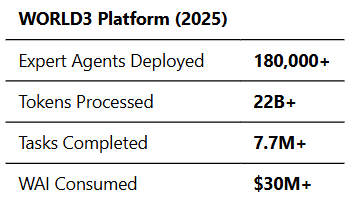
What we’ve processed since:
The market has validated this need. OpenRouter — a centralized API aggregator — hit $500M+ valuation with 4.2M users and 12T tokens/month.
The difference? They’re centralized. One company controls access, pricing, and policies.
RouterLink is the decentralized alternative — battle-tested on 180K agents, now open to everyone.
Introducing RouterLink: The Decentralized Routing Network for AI
RouterLink is a decentralized routing layer that provides unified access to multiple AI models through a single, open protocol.
Think of it as a universal adapter for AI — one integration, many models.
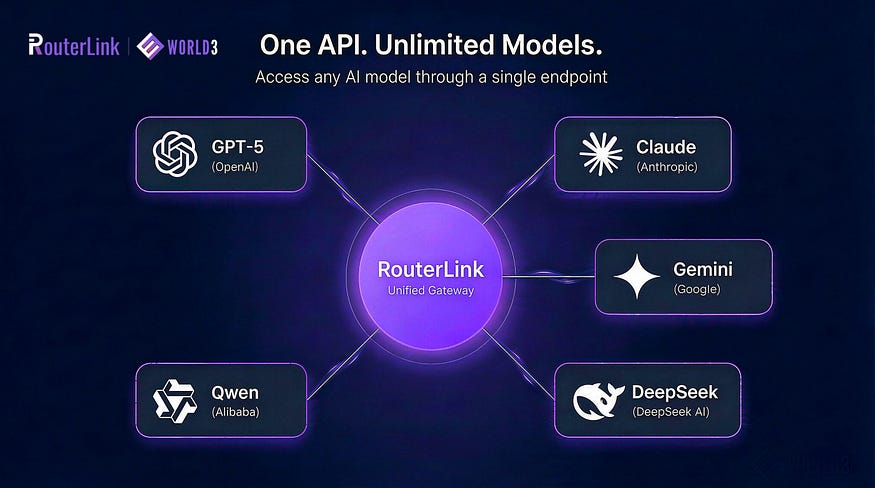
One API endpoint connects to the latest GPT models, Claude, Gemini, DeepSeek, and more — no separate integrations required.
How It Works
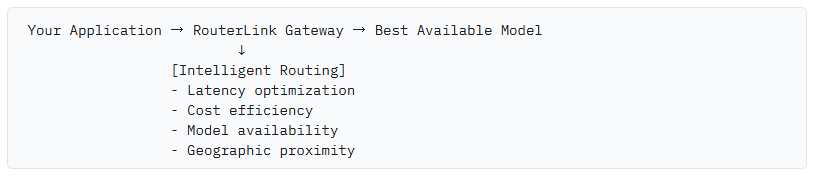
RouterLink sits between your application and AI providers, intelligently routing requests based on your preferences:
- Submit a request through RouterLink’s unified API
- Routing engine evaluates available models based on your criteria
- Request is forwarded to the optimal provider
- Response is returned with full transparency on routing decisions
Key Features
Unified Access
One API, multiple models. No more managing separate integrations for OpenAI, Anthropic, Google, and others.
Intelligent Routing
RouterLink automatically selects the best model based on:
- Latency requirements — Need speed? Route to the fastest available
- Cost constraints — Budget-conscious? Route to cost-effective options
- Model capabilities — Complex reasoning? Route to the most capable model
- Availability — Provider down? Automatic failover to alternatives
Decentralized Infrastructure
Unlike centralized API gateways, RouterLink operates on a decentralized network of nodes. This means:
- No single point of failure
- Censorship resistance
- Community-governed evolution
Verifiable Routing
Every routing decision is transparent and verifiable through:
- Proof of Token Usage (PoTU) — Verify actual token consumption
- Proof of Latency Performance (PoLP) — Verify response times
Why Decentralization Matters
Centralized AI access creates dependencies. When one provider has an outage, your application goes down. When pricing changes, your margins disappear. When policies shift, your use case might suddenly be prohibited.
RouterLink distributes this risk across a network of providers and nodes, ensuring:
- Resilience — No single point of failure
- Freedom — No single entity controls access
- Transparency — All routing decisions are auditable
RouterLink exists so AI access is governed by protocols, not policies.
RouterLink Network Genesis Program
RouterLink is launching with the Genesis Program — an invitation for infrastructure partners, staking operators, and AI-native teams to become founding operators of the network.
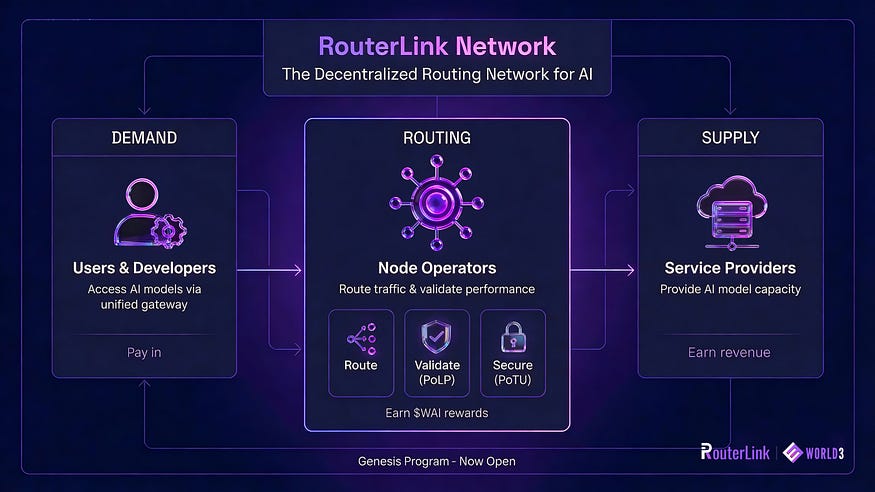
RouterLink Network: Demand (Users) → Routing (Node Operators) → Supply (Service Providers)
Three Roles in the Network
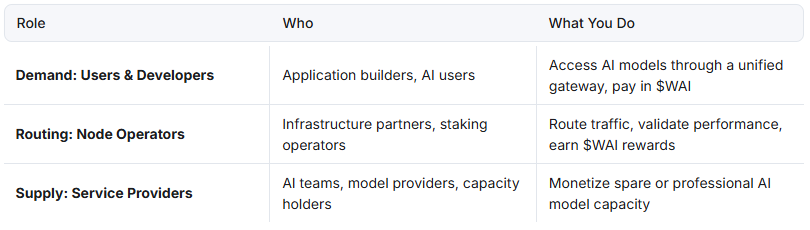
What Genesis Partners Do
Genesis partners operate RouterLink Nodes — the backbone of the decentralized routing network:
- Route user requests to optimal AI endpoints
- Validate network performance through PoLP (Proof of LLM Performance)
- Secure the usage ledger through PoTU (Proof of Token Usage)
- Earn $WAI from routing fees, validator rewards, and $WAI Vault distributions
Genesis Program Roadmap: 3 Stages
The Genesis Program unfolds in three progressive stages:
Stage 1 — Alpha (Now Open)
Status: Application-based partner nodes are live
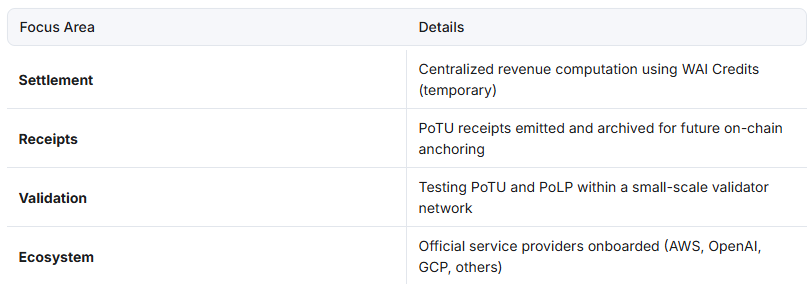
Alpha Partner Requirements:
- One-time license fee in $WAI
- Per-node operational deposit (bond) in $WAI
- Infrastructure capability and commitment
Stage 2 — Beta (Coming Soon)
- Staking conversion — Alpha deposits convert to staking
- Open delegations — $WAI holders can stake to high-performing nodes
- Permissionless service registration — Anyone can register AI services
- On-chain settlement — Transition from testnet to mainnet settlement
Stage 3 — Mainnet (Future)
- Full permissionless entry — Public RouterLink Node onboarding
- Open service registration — No gatekeepers
- Complete on-chain accounting — Transparent, verifiable economics
- Mature $WAI Vault emissions — Sustainable reward distribution
- Slashing live — Security through economic incentives
First-Mover Advantage
Genesis partners receive:
- Early revenue share — First access to network routing fees
- Protocol governance — Direct input into routing policies and benchmarking methods
- Ecosystem visibility — Featured as founding operators in WORLD3 communications
- Strategic optionality — Evolve into large-scale operators, service providers, or delegation hubs
Coming Soon: Major Partnerships
We are thrilled to announce that enterprise-level node partners and major collaborations are joining the RouterLink network.
Stay tuned for upcoming reveals:
- Heavyweight infrastructure partners
- Leading Web3 protocols
- Industry-defining collaborations
These partnerships will shape the future of decentralized AI routing. More announcements coming soon.
Getting Started
RouterLink is launching in early access. Here’s how to try it:
- Visit routerlink.world3.ai
- Connect your wallet or create an account
- Get credits to start routing requests
- Integrate using our simple API or existing tool plugins
Example: Quick Start
from routerlink import Client
client = Client(api_key="your_key")
response = client.chat.completions.create(
messages=[{"role": "user", "content": "Hello!"}],
routing={
"strategy": "cost_optimized",
"fallback": True
}
What’s Next
Over the coming weeks, we’ll be sharing:
- Major cloud partnerships — enterprise infrastructure backing RouterLink
- Genesis Partner announcements — who’s already building with us
- Deep dives into routing strategies
- Technical details on our verification mechanisms (PoTU & PoLP)
- Integration guides for popular tools
Follow @world3_ai to catch every announcement.
RouterLink is more than a product — it’s a step toward an open, interoperable AI ecosystem where developers have choice, applications have resilience, and users have freedom.
Join us in building the future of AI access.
Related Links
- 🌐 Official Website: routerlink.world3.ai
- 📝 Litepaper: docs.world3.ai/world3/routerlink-litepaper
- 📖 Quick Start Guide: https://docs.world3.ai/world3/how-to-guides/routerlink/quick-start-guide
- 🤝 Genesis Program (Alpha): https://routerlink.world3.ai/?tab=alphaprogram
- 🐦 Twitter: @world3_ai
- 💬 Discord: discord.gg/world3
- 📢 Telegram: t.me/world3_ai